IRDAI September 2026 Draft Paper: How Brokers Must Restructure Commission Tracking & Disclosures
The Insurance Regulatory and Development Authority of India (IRDAI) released a consultation paper in September 2026 that could fundamentally change how insurance brokers in India track, report, and disclose their commissions. The paper addresses long-standing concerns about opacity in insurance distribution - concerns that have made brokers vulnerable to regulatory action while quietly eroding their profit margins.
If you are a broker, corporate agent, or financial director, this paper directly affects your business. Here is what it says, why it matters, and what you should do about it.
What the Draft Paper Actually Proposes
The consultation paper focuses on three core areas:
1. Itemized Commission Disclosures
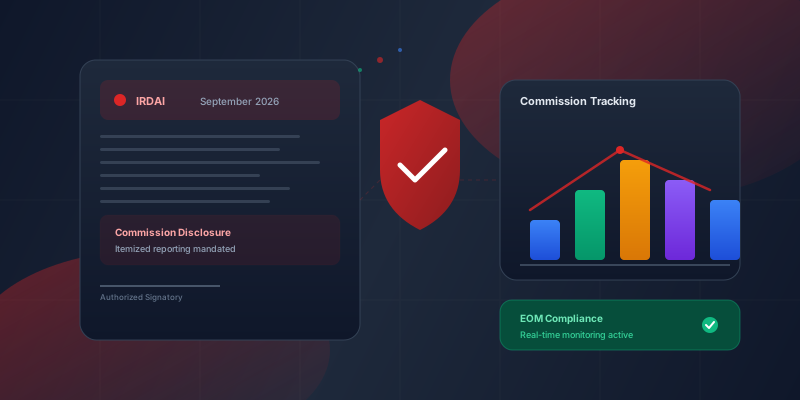
IRDAI wants brokers to move beyond lump-sum commission reporting. The draft proposes that every commission received from an insurer must be broken down and disclosed at the individual policy level. This means showing exactly how much was earned on each policy, for which insurer, and under what arrangement.
The regulator’s reasoning is straightforward: when commissions are reported as single aggregated figures, it becomes nearly impossible to detect mis-selling, churning, or improper incentives. Itemized disclosure makes the entire chain transparent.
2. Calibrated Payout Structures
The paper proposes caps and calibration rules on commission payouts, particularly for high-value policies. The goal is to prevent situations where a broker earns a disproportionately large commission on a single policy - a scenario that can create misaligned incentives and encourage unsuitable product recommendations.
For brokers, this means reviewing your current payout agreements with insurers and understanding how the proposed calibration rules would affect your revenue mix.
3. Strict Expense of Management (EOM) Compliance
The Expense of Management framework governs how much insurers can spend on distribution costs. The draft paper tightens EOM enforcement, requiring brokers to maintain clear documentation that their commissions fall within permissible limits.
This is where most brokers face the biggest operational challenge. Manual commission tracking - the spreadsheet-based approach still used by many brokerages - makes EOM compliance nearly impossible to demonstrate during an audit.
Why Manual Commission Tracking Is a Regulatory Liability
Most mid-sized brokers in India still track commissions using a combination of Excel sheets, email threads, and manual data entry. This approach creates three serious problems:
Regulatory vulnerability. When IRDAI asks for commission records, a broker using manual systems cannot produce clean, reconciled data quickly. Discrepancies between what the insurer paid and what the broker recorded are common - and they raise red flags during inspections.
Revenue leakage. Manual tracking means missed commissions. Insurer payout statements arrive in different formats, get forwarded to different people, and often contain adjustments or deductions that go unnoticed. Over a year, these small leaks add up to significant lost income.
No audit trail. If a dispute arises with an insurer over commission amounts, a broker without a proper system has no defensible record. Emails and spreadsheets are not audit-ready documentation.
How IMD.Mitra’s Commission Management System Solves This
This is exactly the problem that IMD.Mitra’s Financial & Commission Management System was built to address. The platform automates the entire commission lifecycle:
Automatic reconciliation. The system imports insurer payout statements and reconciles them against your internal ledger automatically. Every commission amount is matched, every discrepancy is flagged, and every adjustment is tracked.
Clear audit trails. Every commission transaction is logged with a timestamp, source document, and approval chain. When IRDAI asks for records, you produce them in minutes - not days.
EOM compliance monitoring. The system tracks your commissions against EOM limits in real time, alerting you before you breach thresholds. This proactive approach replaces the panic of discovering a compliance gap during an audit.
Margin protection. By ensuring every commission is captured and reconciled, the system protects your profit margins from the silent erosion that manual tracking allows.
What Brokers Should Do Now
The consultation paper is not yet final, but the direction is clear. IRDAI has been moving toward greater transparency in insurance distribution for years, and this draft paper accelerates that timeline.
Brokers who wait for the final regulations to be notified before acting will face a rushed, stressful compliance exercise. Brokers who invest in proper commission tracking now will be ready when the rules take effect - and will have already stopped the revenue leakage that manual systems cause.
The practical first step is to audit your current commission tracking process. If it involves spreadsheets, manual reconciliation, or any process where a single person holds critical commission knowledge, it is time to explore automated alternatives.
The brokers who thrive under the new regulatory framework will be those who treat commission tracking not as an administrative burden, but as a strategic function that protects revenue and demonstrates regulatory integrity.